Sunday, January 5, 2014

Relaxing in a Sea of Rice Paddys

On the second leg of our holiday vacation triumvirate we ventured to Bali.

I have to sheepishly admit that in the planning process for this trip, I was not at all into Bali. Bali sounded very commercial and overdone (I've heard from friends "think Australian's Cancun, spring break-style"). Brian pushed this into the itinerary, and after finding acceptably priced flights and connecting times, I scheduled three days, four nights in Bali. And now I totally admit I was wrong. I L-O-V-E Bali!

But first a note on transit. To fly from Pankalan Bun to Bali, we needed to connect in Java. Our connection, in Surabaya on the northeast end of the island, was scheduled for six hours. Indonesia is a county stretched across an archipelago of about 6,000 inhabited islands (with another at least 11,000 uninhabited islands!). Some islands - Sumatra, Java, Borneo - are huge. Others are tiny. There are over 700 indigenous languages spoken in cultures across three time zones. A majority of the population is Muslim, although the island of Bali is nearly entirely Hindu. As Brian also said in the last blog, I'm so very impressed with our kids becoming exceptional travelers in such a short time. Transit time really did fly by. We played a bunch of card games, enjoyed dinner and a beer, and indulged in a tremendous game of Carcassone, our new family-favorite game. Upon arriving at the departure gate, we saw that the flight was slightly delayed. About 15 minutes before the new scheduled departure time, there was an announcement in Bahasa Indonesian and a mob stormed the gate grabbing Styrofoam packages. I went to check it out - as I watched, the notification sign changed from "Delay" to "Refreshment". I went back to Brian, informing him and the kids to bunker down for a long delay. With a belly full of AirAsia-provided Nasi Goreng, we took off another two hours later.

Our first lunch in Bali. Food in Ubud is delicious and healthy!
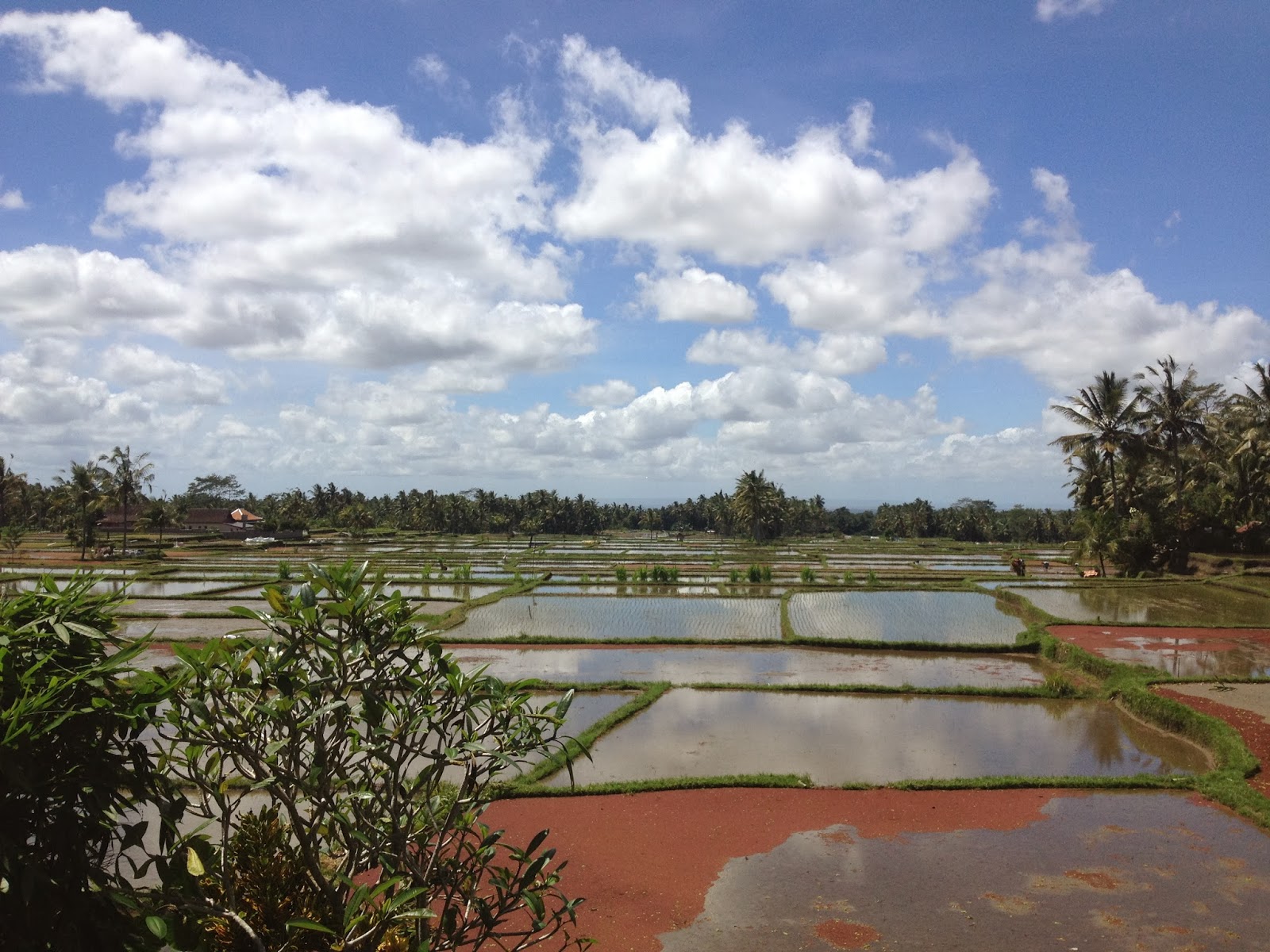
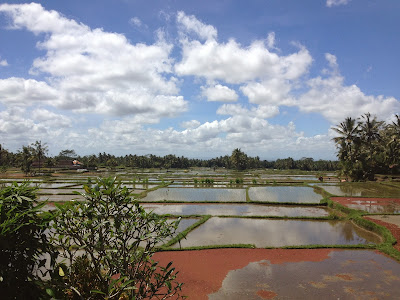
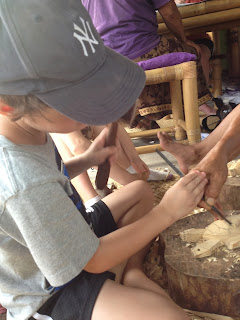
We opted to avoid the beach party scene (foam party, anyone?) and headed toward inland Bali. We arrived at the beautiful Infinity Villa near Ubud, Bali in the middle of the night, settled down, and then woke up to a breathtaking view of a 360 degree sea of rice fields. http://www.infinity-villa-ubud.com/ The kids swam away the morning in the infinity pool outside the villa. Then we headed out to the town of Ubud, the Bali epicenter of art and culture. During our time on the klotok, the kids developed an interest in whittling sticks. Maybe it was just an excuse to use the pocket knife, but they really had a lot of fun with it. So in looking at the cool craft classes we could take that afternoon, we all opted for wood carving.

I was a bit skeptical when the master carver had us select our models - Violet choose to make a dolphin, Tyler a sea turtle, and Brian a gecko. The wood tile designs feed my need for symmetry so I selected a beautiful but complex pattern. Our carving master sat us down and assured us that we could replicate the models. With an unbelievable calm, the carving master handed my six-year-old a razor sharp chisel and hammer, and instructed him where and how to cut away to wood. The three hour course flew by -- so fun! It's cool to be at a place with the kids now that we can all do an activity or take a lesson together. We were all beginners, starting at the same level, and having tremendous fun.


After the class we went to a traditional Balinese Kecak, or fire dance. The Kecak has no musical instruments and, instead, a chorus of 100 men chant throughout the performance, mimicking a pack of monkeys. Now that we have more than one monkey experience under our belts, I can verify that they did indeed sound like monkeys. The monkey song is meant to put a devotee into a trance who at the culmination of the performance kicks and dances on a big pile of coconut shell embers. All in all, it was a good performance, with exceptionally cool chanting.

We spent Bali day #2 at an elephant sanctuary and wildlife park. While elephants are not native to Bali, the Sumatran elephant, a subspecies of the Asian elephant, is native to Indonesia's islands of Sumatra and Borneo. Deforestation is threatening these elephants in a similar way as Malaysia's elephant population. The elephant sanctuary has relocated about 30 elephants that were captured in palm plantations and would have otherwise have been killed. We took an elephant ride and spent hours feeding the juvenile elephants. The elephant park is beautiful. By all accounts they are doing it right. Lots of space, lots of clean water. Long term, one-on-one relationships between an elephant and its trainer. But it also highlighted again the impacts of deforestation and there was a sadness to see these giant refugees. We spent the afternoon touring local Hindu temples; one was right out of an Indian Jones movie! Tyler even found and stepped on a family of cave-ducks: think Rodney Dangerfield a la Caddy Shack, and you might get this family inside joke. (Yes - Brian added that line during the editing process).


A quick dunk at the Water Temple...
...followed by meditation.
The super old and really amazing Moon Temple.


The wonderful owner of the Infinity Villa said that the Ubud "must do" is a rice paddy bicycle tour. This was only slightly complicated since our kids can't yet ride bikes. Or as Violet said "I can ride a bicycle. I just can't start or stop. Or turn." Brian did a quick round of research and found a bicycle tour company with tandem bikes. We were in! So for our last day in Bali, our guide picked us up in the morning and we headed for the volcano. Along the way, we stopped at a coffee plantation and learned about coffee growing and roasting. We also met the furry little Asian palm civet, a nocturnal weasel-like creature that eats coffee beans and then poops them out. The coffee makers, after collecting these beans, roast them as sell them as Kopi Luwak for like $100 a pound. Brian and I sampled some coffee - it was okay, but in no way worth the price tag. But Tyler loved that we were drinking "poop coffee."


We continued our drive past the volcano and then met up with our advance team. They had the bikes ready. So the tandem bikes were actually tandem bikes for ADULTS. Vi couldn't even reach the peddles. Fortunately, the tour guides knew the childrens' dimensions and they'd affixed a short bamboo pole across the bike frames for the kids to rest their feet (maybe not the safest, but we'd brought the childrens' bike helmets from KL so we should get some points for that). The rig worked surprisingly well. Our fantastic guide grew up as a rice farmer and along the tour he shared with us a wonderful wealth of knowledge on rice growing. It's laborious, unrelenting work that showcases an ancient yet well-preserved system of resource distribution. Water is centrally channeled and farmers downstream must coordinate the field flooding and harvest patterns. He also shared some sad accounts of land and wildlife changes since the introduction of industrial pesticides. Amid the breathtaking scenery, I am pleased to report that no child fell off his or her bamboo bike perch.


For those in our region, Bali is an easy and wonderful vacation spot. Ubud has great accommodations and delicious, healthy food. It's chill and relaxed, yet with a wealth of activities. And with a direct flight from KL to Bali, we can be there in two hours for as little as $100 on AirAsia -- yes, I have already looked for flights to go back!

Next stop in the holiday adventure - a middle of the night flight back to Java for a 6:00 am arrival in Yojyakarta.

But for now I leave you with a cockfighting picture. Well actually, it's a post fight shot. The winner, on the left, returns home for a shower and massage. The loser, on the right, is already cleaned up and ready to be dinner.


Saturday, January 4, 2014

Christmas in Borneo with the Orangutans

We just returned from the most amazing family trip that we have ever taken. There are so many things that we want to share with you so we are going to divide the trip into 3 separate posts, one for each of the places we visited over the last 2 weeks: Kalimantan (Indonesian Borneo), Bali, and Jogjakarta (Java).

Since I studied non-human primate communication in college (basically I fed fruit loops to monkeys while playing them different sounds), Mary has tasked me with writing about our experience with the orangutans in Borneo. I was definitely the most qualified to dodge flying primate poop so we'll see how that translates to the blog...

Robin (of Camp MillerWiener) gets pretty much all of the credit for this part of the trip since she came up with the idea of spending Christmas with the orangutans, she found the guide, she booked the houseboat, etc. - you get the idea.

First a little background on Kalimantan. Kalimantan is the southern part of Borneo claimed by Indonesia. Near the southern edge there is a national park called Tanjung Puting, which is the primary home to one of the two remaining subspecies of Orangutans in the world, the Borneo Orangutan. The other subspecies is also in Indonesia on the island of Sumatra. In the 1960s there was intense scientific interest in studying the behavior of our closest animal relatives, the great apes. Louis Leakey was one of the most instrumental figures in this movement. Dr. Leakey is probably best known for his work as a paleontologist, researching early hominid fossils in Olduvai gorge in Tanzania. He strongly believed that studying our closest primate relatives would help uncover clues as to how our early ancestors lived. He funded Jane Goodall to study chimpanzees in Gombe national park in Tanzania and Diane Fossey to study mountain gorillas in Congo and Rwanda. Shortly before his death he funded a third female scientist, Birute Galdikas, to study Orangutans in Indonesia.

Dr. Galdikas has since become one of the world's foremost experts in orangutans. Shortly after arriving in Indonesia she established "Camp Leakey," a research/feeding station where she first tracked and observed orangutans. She also started a program to rehabilitate baby orangutans that had been either taken captive as part of the pet trade or orphaned when their mothers were killed for meat. Her early work laid the foundation for the national park and the 3 feeding stations we ultimately visited. (For anyone interested in learning more about orangutan research in Indonesia you should definitely check out "Intimate Ape," by Shawn Thompson.)

Getting to Kalimantan was not exactly straight forward. We had to fly from KL to Semarang (a small city on the island of Java) and then on to Pangkalan Bun, the a small city in Kalimantan. We were so proud of the kids during this part of the trip as they made it through the multiple delays and various transfers with a smile. They would not have been able to handle the uncertainties of this type of trip 6 months ago. After 11 hrs on the road, we finally met the Wieners and boarded our Klotok (a large houseboat) to start our adventure.

We absolutely loved the klotok. As we sailed down the Sekonyer river, we were slowly enveloped by the rain forest and happily left the city behind (fours days with no iPads, no email, no phone...).


For the next 3 nights and 4 days we lived on the deck of the klotok. There was a large table for meals and at night our guides would set up futons and mosquito nets so we could sleep outside.  


Within minutes of starting the trip we were in the secondary forest and spotted proboscis monkeys and even an orangutan from the boat. The first night we anchored along a shore that was home to thousands of fireflies. They weren't the synchronized fireflies from Kelip Kelip but it was an incredible backdrop to a great dinner of local chicken curry and fresh fish. Alas, my iPhone camera was not good enough to capture the fireflies mingling with the stars.  

After a leisurely breakfast the next morning we set out for Camp Leakey and our first real encounter with orangutans. As we stepped off the dock at Camp Leakey we were met by Peta. She is the daughter of Princess, one of the first orangutan orphans studied by Dr. Galdikas (all families share the same first letter, a technique used by Jane Goodall when she started following chimpanzees). Princess used to wait on the dock for visitors. She was in the orangutan hospital with a shoulder injury during our visit so apparently Peta was minding the family business while she was away.  

Peta and baby meeting us on the dock!
We hiked about a kilometer through the forest towards the feeding station for Camp Leakey, a wooden platform in a small clearing. About halfway to the station our guide spotted a gibbon (another from the ape family - this one a "lesser ape" vs a "great ape") and the kids coaxed it down from the tree with an offering of some apples.


As we arrived at the station, the park rangers laid out bananas and fresh milk and called out to the surrounding orangutans. Waiting for them to arrive was my favorite part of the day. You could hear them in the distance and see the trees bend a little more than they normally do from the wind as they approached. There was a rope that prevented us from getting closer than about 10 meters from the station, but the orangutans didn't seem to notice as some of them came right through the gathered observers to get to the platform.   


Initially, only females came to feed but after about 20 minutes or so, one of the larger males in the area came to the platform. He was--simply put--one great big ape. Males are typically a lot larger than females and as they become dominant they develop enlarged cheek pads that aid in their long calling and are a sign of their status. As big as this guy was, he was not even the king for that area. We never did get to meet the king, Tom, but we were treated to about a 30 second all out brawl between the larger male and a smaller one that was trying to make his way to the feeding station. I've never been on an NFL field but I imagine that offensive lineman move with the same unexpected speed and ferocity. (Some friends we met on another klotok did get to meet Tom. As they left the feeding station they found him enjoying a meal in the park ranger's kitchen! When a king orangutan invites himself over for dinner, you welcome him in...)

This male was not even the biggest in the area!
The following day we visited two additional research stations further upriver and had similarly cool experiences. Tyler discovered a new interest in photography and was never more than 3 feet away from Robin and her excellent camera!  


My favorite part of the day happened while we were docked at the second station waiting to hike into the feeding platform. A young male sat in a tree by the dock. As Violet and I approached he slowly came down towards the ground. We stood there for about 10 minutes watching each other from about 5 meters away until he yawned and showed us his rather large teeth. We decided to slowly back away (Tyler, who had joined us about halfway through ran backwards faster than I thought humanly possible - he had learned from our guide not to turn your back and run from an orangutan since that is a sign of weakness). 


We still had about 30 minutes until the hike so Tyler and I joined a soccer game of tourists vs. park rangers (plus a really fast Australian kid). Needless to say the predominantly American team with the two baseball guys got smoked, although I did manage to steal the ball from a ranger (but promptly kicked it into the river when I got too excited). Mary was too busy eating delicious fried bananas with our new Australian friends to take any pics.

The last feeding station might have been my favorite. Everyone left after about twenty minutes because it was rainy, hot and really mosquito-filled. As we turned to leave, Violet grabbed my arm and asked if I would stay with her. After bathing in DEET we sat together watching Orangutans for almost an hour.  It was awesome.


Back on the boat we prepared to celebrate Christmas Eve. We anchored on the shoreline about 20 meters from a group of proboscis monkeys and watched as they jockeyed for position in the trees as the sun began to set. There were 3 males in the troop that were in a constant battle to get to the top of the tallest tree. Best TV show I've ever watched. 


I read 'Twas the Night Before Christmas' as the guides cleared the dinner table. After dinner we had a rousing round of Christmas carols with our surprisingly well-versed non-Christian friends! We also played some Christmas Bon Jovi. (From Mary: Our murderous attempt of Stairway to Heaven was my highlight!) (From Brian: Stairway to Heaven is not Bon Jovi, it's Led Zeppelin.) (Mary: Thank you anthropologist, that didn't know a gibbon was a lesser ape, but please do recall we played a diverse collection of songs that evening, including Led Zeppelin, the Eagles, the Beatles, and Billy Joel.)

Well, maybe Tyler wasn't so roused by the caroling...
The kids were a little nervous that Santa wouldn't be able to find us in the middle of the rain forest on a boat in Borneo but after some reassurance they finally all got to sleep. Violet awoke at dawn (aka 5:45 am) excited to tell everyone that she had heard sleigh bells and hooves in the nearby palm trees during the night! Low and behold, Santa had left stockings for all 4 children. It was a little weird watching the kids open their stockings through mosquito netting.


Our guide Poncho was fantastic with the kids and made the trip simply outstanding! He even showed them how to weave palm fronds and carve animals from fruit with a pocket knife.
After breakfast we started out on our 4 hr return journey back to Pangkalan Bun. Christmas night was fairly low key. Our hotel had a Christmas dinner complete with an Indonesian acoustic rock band (for those of you who knew me in college, remember Danny Taylor and Brian Garibaldi as "Acoustic Rain"?). We decided to try to explore the city and walked down the hill to a local restaurant. I was super excited to order the duck for Christmas dinner a la "A Christmas Story." When the tiny black, charred thing came out on a small platter I politely inquired what had happened to the duck. The waiter responded in surprisingly good English - "No duck tonight, only pigeon." The rest of the dinner pretty much followed suit.  

After we arrived back at the hotel, we said goodbye to the Miller-Wiener clan since they had to leave at 4 am the next morning to get back to KL. We then proceeded down to the hotel Christmas party to celebrate the end of the first leg of our fantastic holiday journey! The Indonesian acoustic rock band did a not to shabby version of Holy Night. The hotel didn't serve beer but we paid the waitress on the side to bring us some of her stash of Bintang (a local Pilsener). After 4 days without alcohol (long story but the Wieners thought we had gone to duty free in KL and we thought the same about them...) it was nice to have some Christmas cheer.


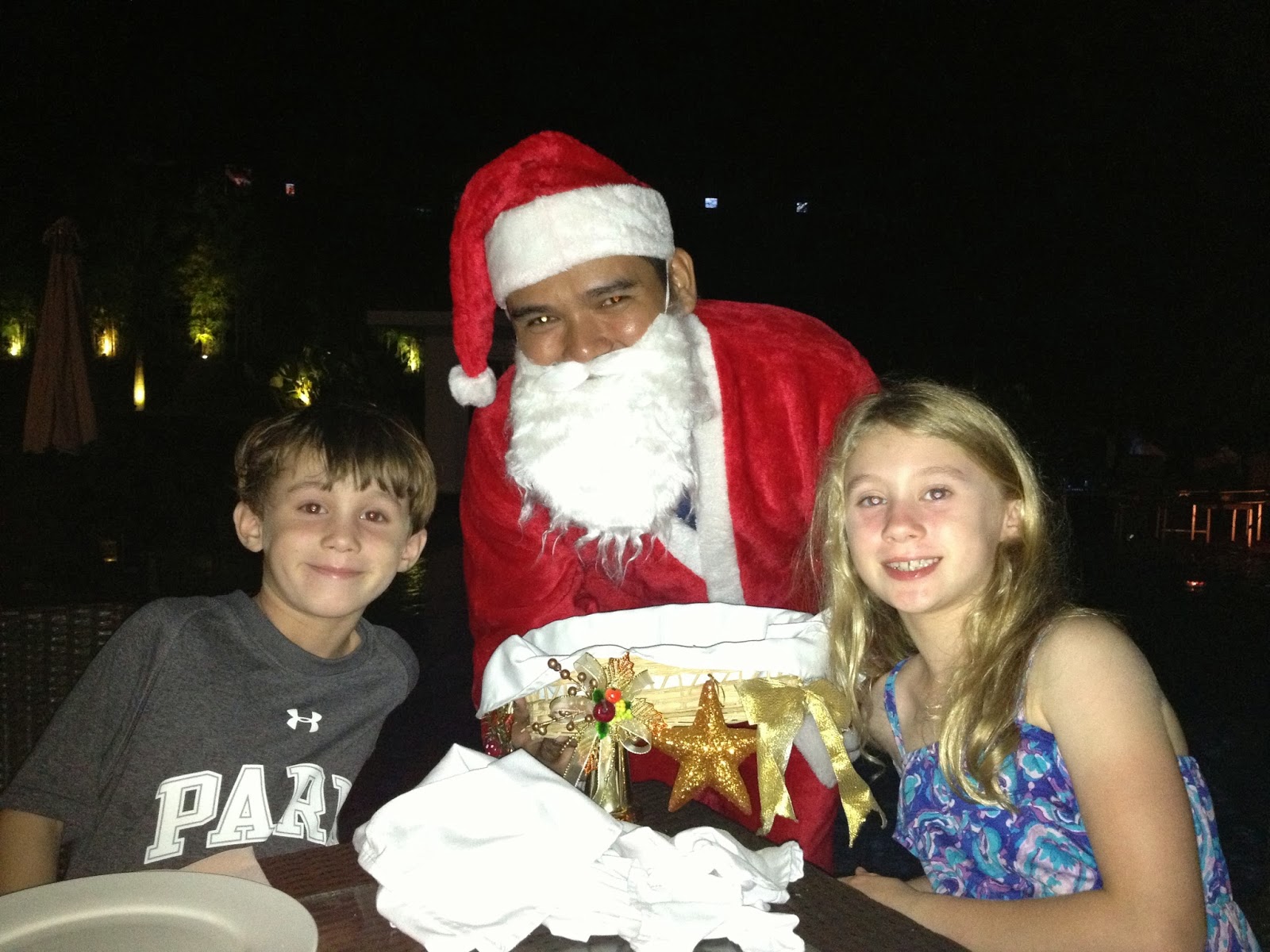
Santa passing out chocolates.
A special thanks to the Miller-Wieners for making this an incredibly memorable Christmas. Mary has said it before and I will say it again - You know that you are truly blessed when you have family who are friends and friends who are family!

A belated Merry Christmas to everyone!

Love, 
Brian, Mary, Violet and Tyler

Saturday, December 14, 2013

Bangon Ormok

I just returned from a medical relief mission to the Philippines. It is difficult to describe the experience since I am still processing all of the events that took place but I wanted to put something into words while the individual events are clear in my mind.

I left last Friday morning at 1 am with a group of 4 PUGSOM medical students, 1 Hopkins psychiatry resident and a PUGSOM OB/GYN faculty member. We took the overnight flight to Manila to meet our Vice Dean, Nicole, before heading on to Cebu to join Operation Smile. Op Smile (http://www.operationsmile.org.ph/) is an international group that specializes in performing cleft palate repairs for children in need. They have a very large presence in the Philippines, partly because the founders began their work there over 30 years ago but also because the Philippines has the highest incidence of cleft palates in the world. In addition to the wonderful work they do with craniofacial surgeries, they are also heavily involved in medical relief missions. Nicole has been working with them for years and this is the second time she has organized a PUGSOM group to participate in a typhoon relief mission in the Philippines.

We left with a lot of uncertainty since none of us had ever been part of a relief mission before. I had worked in a rural clinic in Honduras and some of the other docs had similar international clinic experiences; but, we honestly had no idea what to expect. I think Nicole understood this more than we did and set our Manila airport rendezvous point at a place that she knew would be a source of comfort to the westerners in the group...a pancake house!  After a stack of corn pancakes (I had to try them...) we boarded a flight to Cebu.


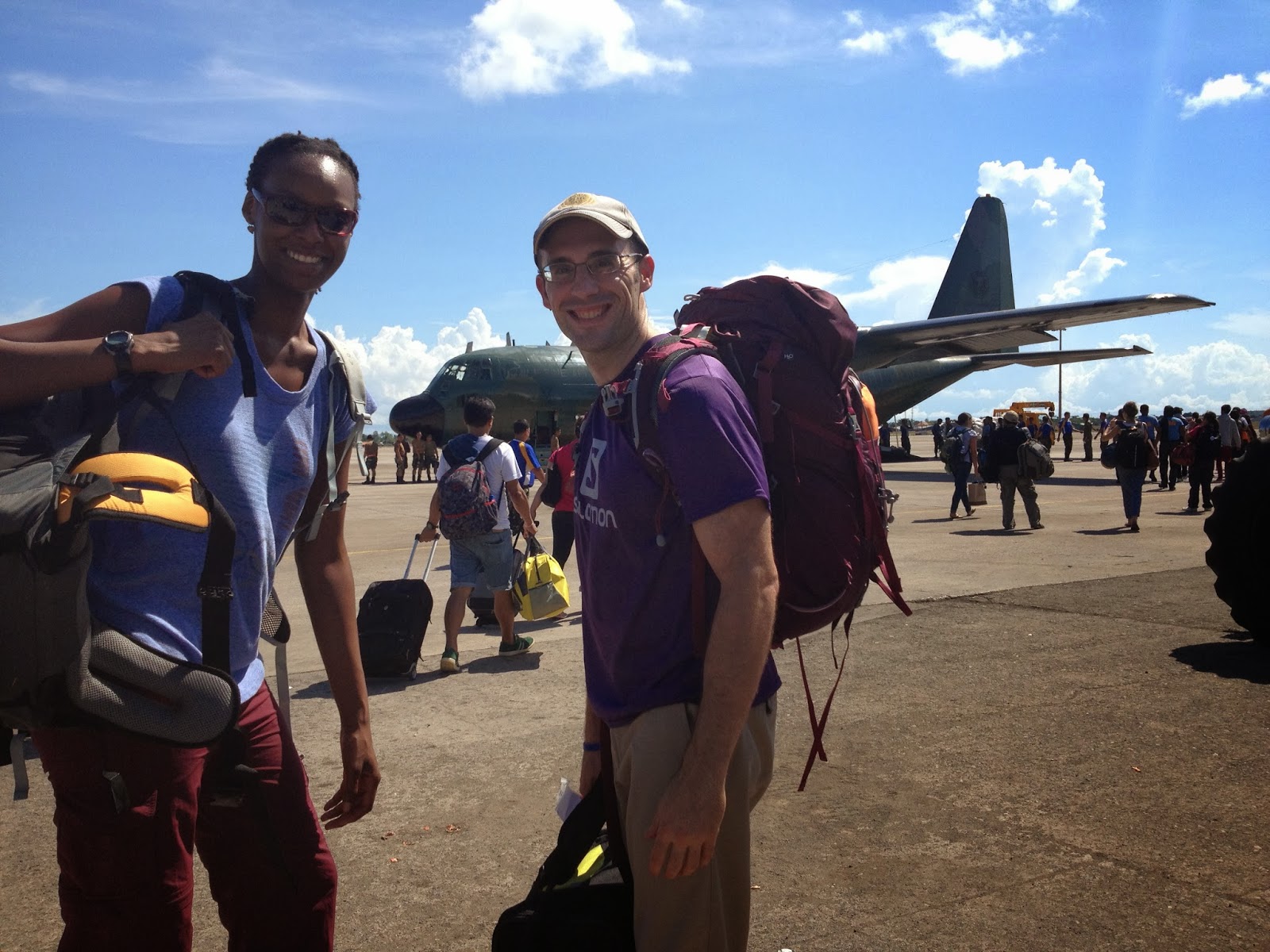
When we arrived in Cebu, the Op Smile team picked us up in a huge white tour bus and we headed off to the Cebu Airforce base to have lunch with the General and then to load our cargo (including us!) into a C130 headed for the city of Ormoc. I have to admit that I was still nervous about the next few days but I was pretty excited to fly in a C130. The excitement was not enough to prevent me from taking a nap lying across our cargo since we had been awake for nearly 30 hrs by the time we boarded the plane.  


When we landed in Ormok, the Filippino army helped us load our cargo into two trucks and two ambulances and we set off for the city. After registering with the local health department we stopped at the hospital to meet the director and to tour the facility.

Ormok is located about 120km from Tacloban which was where the typhoon did the most damage to both human life and property. It was hard to imagine that Ormok had escaped the worst judging by the condition of the hospital. Entire wards on the first floor had lost outer walls, the ceiling, or both and the entire second floor was unusable because the roof was destroyed. As a result, patients were lined up on military stretchers in the hallway, in offices, virtually any place where someone could lie down and in some places where it seemed they could not. Since virtually all of the patients had lost their homes, entire families were camped out in a 24hr vigil around their loved one's bed, oftentimes sharing the stretcher with 2 or 3 people. I was overwhelmed on my way to the director's office. I had no idea how I could begin to help even a handful of the people that I saw lying on those stretchers.
This was one of the medicine wards at ODH that was severely damaged by the storm.
During our meeting with the director, we introduced ourselves and our specialties. When I told her that I was an intensive care unit doctor she very politely apologized that they had no ICU at ODH. Violet would probably have recognized this moment as foreshadowing of the events to come in the next 48hrs. I took it to mean that I would be helping out in the outpatient clinic tent with the volunteers from Mercy Malaysia, a wonderful relief group that was manning that section of the hospital.

After deciding on a plan for the following day we loaded onto the military trucks and headed for our house in Ormok since it was getting late, the sun was setting and we were all pretty tired and hungry.

Our house in Ormok was home-base to our team of 30 and a family of 6 that looked after us.
The most remarkable thing about the house was the family that helped look after us there. They were very friendly, super appreciative of our efforts and excellent cooks!  We had cold showers, a generator for lights and a working fridge to keep the San Miguels cold. Even though there were over 30 of us in the house I honestly never felt cramped. I also did not spend a lot of time there once we started working.

One experience from the house I would like to share is my first encounter with Balut. Balut is a duckegg with an embryo inside that is then boiled and eaten, usually at around the 2 week incubation time point. The resulting egg has a well-formed embryo and a large yolk sac. You crack the top, drink the liquid inside like a soup and then eat both the embryo and egg. I was excitedly offered Balut as soon as I dropped my bag. I felt like I was being tested, so I had to give it a go. To be honest, it tasted like chunky chicken soup!
This is not my Balut but an image taken from Google.  It pretty much looked like this though.
Saturday morning we got up early and were ready to go to work. We were divided into 2 teams: a hospital team and a community team that would go to different towns and set up mobile clinics. I climbed onboard the hospital team ambulance with my stethoscope, a power bar and a bottle of water thinking I would be home in time for dinner. I barely made it back in time for Sunday dinner...

When we arrived at the hospital I met the internal medicine doctor on call for ODH and she asked if I was comfortable manning the Emergency Department while she rounded on the 50 medicine inpatients throughout the hospital and various satellite tents. It was busy to say the least.  In about 3 hrs I did 10 admissions and 2 pre-op consults, not to mention a number of outpatient evaluations.

After taking a short break for lunch I decided to see how the rest of the team was doing in the surgical area. I found Nicole in the recovery room tending to a 10 year old boy, AA, who had a suspected abdominal infection and had undergone emergency exploratory surgery. He had a breathing tube in place but since we did not have a ventilator, the team was taking turns bagging him while Nicole adjusted medications and spoke with family members. He was essentially ODH's first ever ICU patient. While I was there taking my turn as the ventilator, our OB asked if I would see a patient who had a problem with swollen legs after she delivered her baby 5 days earlier. Within seconds of meeting JA it was clear that she was in decompensated heart failure and needed IV medication and close monitoring. She became ODH ICU patient #2. ICU patient #3 was a 47 year old woman who came to the hospital 5 days before our arrival with a possible pneumonia. The on-call doctor asked me to have a look at her because she was more short of breath than usual. This turned out to be an understatement and we had to intubate her (place a breathing tube) shortly after I met her. ICU patient #4 was a patient that I had admitted earlier in the day with a suspected MI. The oncall doctor asked me to re-evaluate him after he developed worsening chest pain and had dangerously low blood pressures. He became ICU patient #4. By midnight on our first day, Nicole and I had unwittingly turned the recovery room into what would be recognized in most hospitals as a true intensive care unit.
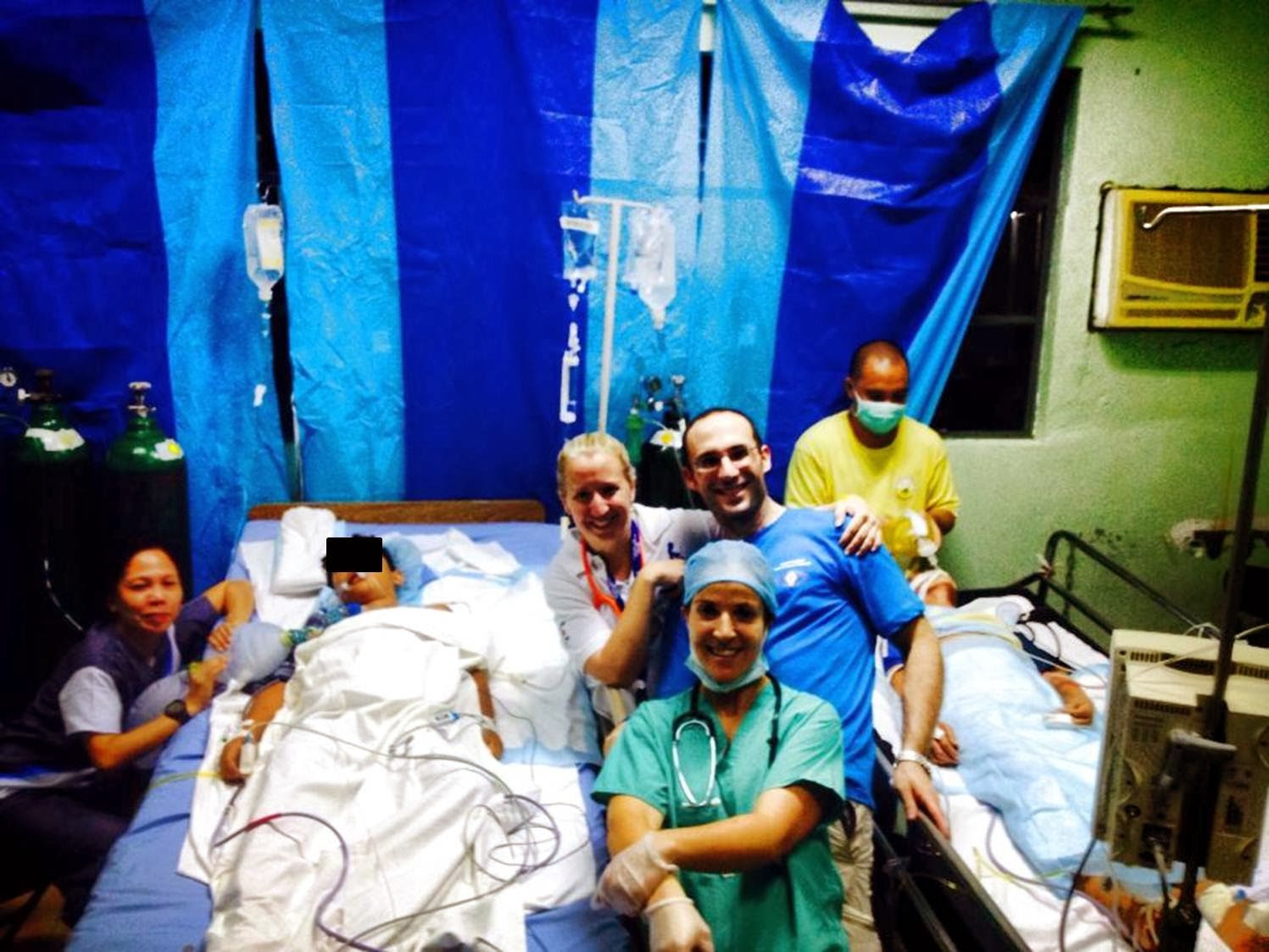
The on-call ICU team on the first night in the new ODH ICU
It was a crazy night. We mixed our own IV medications, pushed our own drugs, traded with the hospital pharmacy for some others, and manually bagged 2 of our 4 patients for over 12 hours straight. Unfortunately our 10 year old didn't make it. I don't want to go into the details but we did everything we could and then some but he still was not able to pull through. It was a painful reminder of why I admire pediatricians and could never be one myself. It is not easy for me when an adult patient dies in the ICU but there is something especially terrible about losing a child. Nicole was unbelievable in the way she took care of AA throughout the night but was even more incredible in the way she spent time with his family. It was a privilege to work with the folks who made up our ICU team that first night.

After AA died, I began to think about the possibility that our other patients in the ICU might not make it through (thankfully they all did). Around that same time I had another equally disturbing thought: What would happen to them if they were still alive on Wednesday morning when our team was scheduled to leave but they still required ICU-level care? Who would look after them? How would they survive? I had not thought about these issues when I initiated a higher level of care to keep them alive in the first place. I had also never considered the issue of resource allocation in a disaster situation. Were we devoting too many resources (i.e. both medication and man-hours) to too few patients?

Before we were able to really delve into these issues about disaster resource allocation, Nicole met baby P. I think Nicole was just walking to the bathroom, getting ready to see some pre-ops for the morning cases when she noticed a 3 month old baby girl breathing fast and turning blue on a stretcher near the ER. Her mother was there crying but there were no doctors or nurses around to assist. She ran for her anesthesia bag and placed a breathing tube to keep her alive. We were able to get a chest xray on the way to our ICU which showed that Baby P had a bad pneumonia and bilateral pneumothoraces (air pockets around the lungs). We didn't have proper chest tubes so Nicole inserted IV catheters directly into Baby P's anterior chest wall to try to evacuate the air. Our medical mission director then McGuivered chest tube bottles to keep the air from re-accumulating.  It was amazing to watch them at work.

Nicole and me with Baby P.  Her family gave us permission to use her story and her photos if it would help other kids in the future.
From that moment on, the rest of the mission for many of us became about Baby P. Baby P is the youngest of 4 children. Her dad is a coconut farmer but his entire plantation was destroyed by the typhoon. It takes 10 years to grow a coconut tree so you can imagine that their family is in a world of trouble financially. At the time she got sick, they were living with her grandmother and 15 other extended family members in a 2 room shack. Her story was very similar to almost every other patient we saw.

Once it seemed likely that Baby P was going to survive the first few hours of her ICU stay we had to devise an exit strategy to get her to the nearest pediatric ICU in Manila (Note that the "we" here is like me saying to Mary that "we" need to get the chocolate stains out of Violet's school uniform). Again, Jojo and Nicole were amazing to watch in action. Ultimately Nicole and two other Op Smile members took 3 ambulances and another C130 to get her to the children's hospital in Manila where she is holding her own at the time I'm writing this. 

On our last day in Ormok the entire group went with the community team on a mission to a town near Tacloban. The army was, as always, amazing. They arrived before us and set up clinic tents, a dental surgery room, and an area where they put on magic shows for the town children. We saw about 250 patients in 3 hours. For most patients, especially the children, we dispensed vitamins, tylenol and cough syrup, but there were a few patients with bad skin and upper respiratory infections that were in serious need of antibiotics. Probably the most important material things we provided were clean water tablets and rehydration packets but I think that our presence there meant more than just the supplies. It's difficult to quantify what effect we really had but seeing the children playing, laughing and running around with our group, I hope that they were able to have at least a few hours free of the worry they've had since the typhoon struck.


The highlight of the afternoon was lunch! The military put on a traditional feast called "Boodle Fight." They prepared rice, glass noodles, chicken, sausage, beef, pineapples, bananas and of course, sardines and spread them out over huge banana leaves that covered a long table. We all gathered around the table and Colonel Fernandez had us turn to the left and put our left hand behind backs.  We then raised our right hands and on the colonel's count of "3" we all screamed "Boodle Fight" and began shoveling food into our mouths with our right hands as fast as we could. It was like trying to eat pancakes from the same plate as Tyler. I thought at one point I might lose my hand to a large man with grenades slung around his chest.


After lunch the military took us on a motor tour through the city of Tacloban. Words cannot properly describe the unbelievable destruction we saw as we drove into town. It looked as if someone had picked up the entire city 50 feet into the air and then slammed it back down into the ground. Trucks were on top of trees, entire fields of debris covered areas where I imagine houses once stood, and signs were lining the street asking for food and clean water. I was overwhelmed by the enormity of the task ahead to rebuild the city but I also had a sick feeling in my stomach that another typhoon would likely strike before they would be able to complete the project.
This is just one photo of many. I honestly stopped taking them after the first few minutes since I knew I would never be able to capture the feeling I had with a photo.  
There were a few times during our trip through Tacloban that I felt guilty, like a motorist stopping to view the wreckage on the other side of a 4 lane highway. But I think it was important to see what the people in Tacloban and in other parts of the Philippines are facing. It brought our own short relief mission into a broader perspective.

After our tour through Tacloban, the military brought us back to their headquarters in a town called ByBy where they treated us to a final dinner. I don't remember much after that as I fell asleep in the truck on our 90 minute drive home.
The blue bottle might explain my ability to sleep on a rocky mountain road on a hard military truck bench.
The colonel and his men made sure that we were taken care of throughout our stay in Ormok!
We arrived home and packed up since we had to leave the next morning on a ferry to make our way back to Cebu.

Overall I had an amazing experience. I am honestly still processing some of the events that I've described and some of the questions that they raised and probably will be for some time. I can't thank JoJo, Nicole and the entire crew of Operation Smile enough for inviting me along and making me feel welcome from the moment I stepped on their tour bus in Cebu. I also can't thank them enough for looking after our 4 students. I also want to thank everyone at ODH who made it possible for me to help take care of patients there.

I hope that everyone is gearing up for a great Christmas and New Year's ahead. While I was writing this I just burned Mary's candied pecans for our neighbor's Christmas party. Some things never change!

Love to all,

Bangon Ormok (Rise again Ormok)!

Brian

Wednesday, December 11, 2013

Giving Thanks (and Christmas Decorating)

I hear there's snow in Baltimore. Here's what it looks like today in KL:

View from our balcony looking down to the pool
First, please let me apologize for the delayed posting! Work's been keeping me busy, but I can't punt this one to Brian because he's away on a medical relief mission in the Philippines. Our friend and Brian's colleague, Nicole, has worked for many years with an Operation Smile team out of the Philippines. While they usually travel to remote areas to operate on children with cleft lips and cleft palates, in times of disasters - such as the aftermath of Hurricane Haiyan (Yolanda) - the team transforms into a mobile med-surg unit. In collaboration with the Philippines Red Cross, a team from Brian's work here at PUGSOM (4 Hopkins docs, plus several students) headed over last week to staff a hospital in Ormoc, an area badly hit by the storm that as of yet has received little assistance. That's about all I know -- communication is limited. The brief message I've received (one one-line text) says that it's hot and they are "extremely busy, but good." Say tuned for Brian's account of his experiences in our next posts. (And forgive all the typos in this post. Brian usually proof reads for me!)  

Anyway, let me catch you up on the adventures of the last two weeks...

The end of November brought wonderful Thanksgiving and Hanukkah celebrations! It was a bit odd to celebrate Thanksgiving (and Hanukkah with the Miller/Wiener's) when no one else is celebrating. In the US for Thanksgiving, work stops for 4 (or 5 or 6) days. Here, the kids were in school on Thanksgiving day and the day after and everyone was working. Robin and I made an executive decision to hold the Thanksgiving celebration on Friday. That way everyone could make it to the party after work and we'd not need to worry about getting the kids to bed.

Robin and Ethan offered to host. It was most certainly Thanksgiving, Malaysia style. We enjoyed all the traditional Thanksgiving foods--turkey, stuffing, cranberries, mashed potatoes, pumpkin pie. But we had a few new ones, too. Turkey is so crazy expensive, that we decided to complement our small turkey with a few extra birds--namely Chinese style crispy ducks. We invited to the celebration all the faculty from Brian's work; some are from the US, others are in KL from across the world. So new favorites to the Thanksgiving menu were homemade palak paneer, butter chicken, and Abhi's lychee martinis. (Note to the Pohl family: We may have to adopt Abhi--he rolled up to Thanksgiving dinner with a mobile bar, complete with blender, shaker, and martini glasses.)

Robin and Ethan's neighborhood indoor/outdoor space was ideal for Malaysian Thanksgiving. The kids swam in the pool all night. There were no American football games played (nor watch on TV) and no turkey trot. Still, at the end of the celebration I had that wonderful warm feeling of bring surrounded by people I love being with, plus a very full belly, and a calmness after the chaos of a great event! Hugs and kisses to Robin and Ethan for hosting.

You have no idea how happy I was to find this...
...Or what a pain it was to cook  4 pies and two casseroles in our (toaster) oven.

Last week, I had a wonderful work-related surprise. It was a huge honor to be invited to participate in an international Joint Learning Network conference titled "Demystifying DRGs" here in KL. The small world just got smaller. The Joint Learning Network is a collection of low- and middle-income nations that form a learning collaborative around issues of universal health care coverage. Health officials from Malaysia, Vietnam, the Philippines, Indonesia, Ghana, India, and Nigeria exchanged practical ideas and advice about hospital payment reform. I participated on two panels, one on the selection of a grouper and the other on post-DRG implementation issues. (Big shout out to Patrick Redmon who returned my Thanskgiving weekend call to share Maryland's experience when moving to APR-DRGs.) In moving to Malaysia, I didn't have any clue that my Medicaid (uniquely American) and HSCRC (uniquely Maryland) experiences could transfer to international work. Maybe I had preconceived ideas of how health finance works abroad. Or actually, I think it was more naivety. Either way, I learned at the conference that these nations' health officials face many similar challenges as we do as government officials Maryland. We're all dealing with big picture financing questions: reimbursement for volume vs quality, allocation of resources. We also deal with all the nitty-gritty logistic things, too, like how to allocate expenses across rate centers in a top down accounting system and how to establish and apply equivalent inpatient admissions to outpatient settings. I very much hope to continue to engage with the Malaysian Ministry of Health team and other countries in the Joint Learning Network. Thank you, Amanda Folsom for connecting me to the JLN team!

Speaking of health (with no HIPAA privacy laws broken) - my friend here needed an MRI of her back. We walked into a private hospital 10 minutes after getting the appointment, got the MRI in a state of the art GE machine, had them slap the images on a DVD, and walked out after paying the bill in cash: $350.00 (US dollars). Anyone want to guess the cost of that transaction in the US? And yes, that INCLUDED the fee for the radiologist read, emailed to my friend a few hours later.

The Miller Wieners came over to our place to celebrate the seventh night of Hanukkah.
(They brought the menorah.)
Last week the kids' school held their annual "Mufti Day". I received 15 emails from the school about this, sent in a bunch of requested money, signed two permission slips -- all still without having a clue what Muft Day was. I Googled "Mufti Day". It means casual Friday or dress down day. Not helpful. Finally I went to Tyler's teacher and just asked straight out - what is this thing? In her most lovely British accent she explained that it is a day in which the kids blow off school, dress up, and have fun. This means a fair with games, candy, bounce houses, etc. For the lower primary, the Year 6 kids (5th graders) staged a carnival. They created games and made prizes. (Think: shoot the nerf gun at the cans, throw a soaked sponge at a girl who tries to dodge, shoot the nurf gun at the cards, kick a ball in a mini soccer goal, shoot the nurf gun at the car.) It was cute(ish). The kids had a blast and collected a huge bag of candy.


While Brian was away this weekend, the kids and I got in the holiday spirit. We asked ourselves, why do we decorate pine trees for the holidays? I'm not talking historically, I'm talking logistically. Why not a maple tree or elm tree... Well, we decided it's because all those others aren't green in the winter. So here in Malaysia, all our trees are ever green year round. So in my mind, there was no need to buy a million dollar imported pine tree. Instead, the kids and I dragged the palm tree in from the balcony and set to work making and hanging origami ornaments. Telling this to my mom gave her a good laugh. When I was a small child, my family lived in Japan and my mom decorated our Christmas tree in origami cranes. The cranes were so hated by my three-year-old self that I smashed them. All of them. Full circle, I guess, as I'm living in Asia and folding paper for our own tree. Except my kids have totally bought into the palm tree idea and love their origami. Maybe all those years I've work on stakeholder engagement are not wasted. We brought along only a few other Christmas things. The stockings are hand made by our family friend, the nativity scene, and a bunch of Spode dishes.

Let me run now. Kids are finishing swim lessons - Violet just learned the butterfly. I see visions of hot milo in our future. Maybe we will watch Elf because "I just like to smile, smiling's my favorite."

And just in case you were worried that we don't have enough Christmas cheer in Malaysia, check out the decorations at the mall!